A sample can be useful. It can help you narrow down a material, compare finishes and get a first sense of colour. But with natural stone, it can also create confidence too early. That is because stone does not reveal itself properly in fragments. A hand-sized sample may tell you the general look of a material. It will not show how the slab reads at full scale, how the veining moves, where the quieter areas sit, or what happens once the stone is cut for an island, vanity, fireplace or feature wall. That is where many decisions start to go wrong.
At WOMAG, we see this often in the showroom. A client arrives thinking the choice is already made. Then the full slab is viewed and the picture changes. The movement may be heavier than expected. The balance may feel different. The slab may still be beautiful, but not right for that application. This is why viewing the full slab is not an optional extra. It is part of making a good decision.
Why a sample can give the wrong impression
Samples have a role. They are useful for early comparison. But they flatten the decision. They reduce the material to colour and finish, when the real decision is usually about composition, scale and suitability. A stone that feels subtle in a small piece may become far more dramatic across a large island. Another may seem too busy in an offcut, then read as calm and balanced once seen in full. That difference matters. In a premium project, the surface is not just filling a practical need. It shapes the room. It changes how cabinetry sits against it, how light moves across it, and how much visual weight the kitchen or bathroom carries. A sample can guide you. It cannot make the full decision for you.
Natural stone is selected, not standardised
Part of the value of marble, quartzite, granite and travertine is that they do not repeat neatly. No two slabs are the same. Even slabs from the same block can vary in movement, tone, density and visual weight. That variation is not a problem to solve. It is one of the main reasons people choose natural stone in the first place. But it also means the material has to be chosen differently. With a manufactured surface, pattern and colour are usually more predictable. With natural stone, the exact slab matters. A small sample may confirm the general direction, but it cannot show the full composition of the piece or how that composition will behave once fabricated and installed. That is often where expectation and reality either line up, or drift apart.

Why scale changes the final design outcome
There is a reason experienced architects and designers want to see the full slab. Scale changes everything.
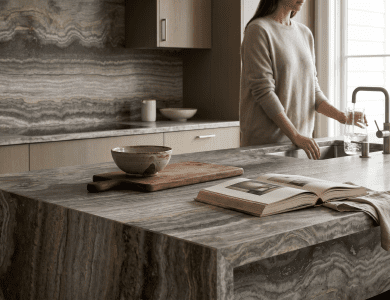
A kitchen island may need enough movement to carry the room, but not so much that it becomes chaotic. A vanity may need something quieter. A fireplace surround may need stronger presence. A bookmatched wall depends almost entirely on balance, direction and how the material opens across the surface. These are not small styling decisions. They affect how the room feels. Once you see the slab in full, you can start asking the right questions. Does it feel calm or busy? Does it have enough movement for the application? Is the veining pulling too hard in one direction? Will it still feel balanced once cut-outs, joins and edge details are introduced? That is the point where the material stops being an idea and starts becoming part of the space.
What you can only assess when viewing the full slab
When you view the full slab in person, you can assess things that a sample simply cannot show:
- how the veining moves across the slab
- where the quieter and more expressive sections sit
- whether the composition feels balanced at scale
- how the slab may read once cut into islands, splashbacks, vanities or wall panels
- whether the material suits a bold statement application or a more restrained one
- how much continuity can be kept across larger surfaces
This matters because different parts of the same slab can behave very differently. It also matters practically. If a client wants the strongest movement across the island, or a quieter section for a vanity, that needs to be decided before fabrication starts, not afterwards.
Why slab viewing matters for fabrication and seam planning
This is where the conversation becomes more practical. Choosing the material family is one step. Choosing the exact slab with fabrication in mind is another. At WOMAG, slab selection is considered alongside application, cut direction, seam placement, edge detailing and the way the finished surface will come together on site. That matters because a strong slab can lose impact if the planning is weak. Veining can be interrupted in the wrong place. A seam can become more visible than expected. The most useful or visually powerful part of the slab can end up cut away from the area where it should have been used. A surface that looked good in theory can feel unresolved once installed if these decisions are left too late.
This is why showroom guidance matters. When clients can see the slab properly and talk through the application with people who understand fabrication and installation, the decision improves. Not just visually, but practically.

Why this matters even more in kitchens, bathrooms and feature applications
The bigger and more visible the application, the less room there is for guesswork. In kitchens, the worktop often becomes the centre of the room. In bathrooms, the stone may need to bring calm without feeling flat. In feature walls and fireplace surrounds, the slab often becomes one of the main visual elements in the space. So the material does not only need to be attractive. It needs to be right for the role it is playing. For architects and interior designers, this is about control. For homeowners, it is about confidence. For developers and builders, it is about avoiding expensive disappointment later. Viewing the full slab helps with all of that.
Why the showroom still matters
There is a reason natural stone is best chosen in person.
At WOMAG’s showrooms in Cape Town and Johannesburg, clients can view full slabs at scale, compare materials properly, and have practical conversations about where each surface will work best. That changes the decision. Instead of working from an approximation, clients can assess movement, tone, scale and suitability in real terms. They can see whether a slab will work for a waterfall island, a backsplash, a vanity, a fireplace or a feature wall. They can also make those decisions with fabrication and installation in mind, which is often where the final quality of the result is won. This is what makes showroom viewing valuable. It reduces uncertainty, sharpens the selection process and gives the project a better chance of feeling right once everything is installed.
A better surface decision starts with seeing more
Natural stone needs to be seen properly. Its value is not only in colour or finish, but in movement, depth, variation and scale. That is why viewing the full slab matters. It gives you a clearer understanding of what you are actually choosing before it becomes part of the build. For anyone selecting stone for a kitchen, bathroom, fireplace surround or feature wall, that step is not a luxury. It is part of choosing with confidence. And in projects where the surface plays a major visual role, it is often the point where the right material becomes obvious.
FAQ
Why is it important to view the full slab before buying natural stone?
Viewing the full slab lets you assess veining, tonal variation, visual balance and overall composition at scale. It also helps with practical decisions around cut direction, seam placement and how the slab will look once fabricated and installed.
Can I choose marble or quartzite from a sample only?
A sample can help you shortlist a material, but it should not be the only basis for a final decision, especially with natural stone. Marble and quartzite can vary significantly from slab to slab, and those differences affect the final result.
What does a full slab show that a sample cannot?
A full slab shows how the movement travels across the material, where stronger or quieter areas sit, whether the composition feels balanced, and how the stone may perform visually in a larger application such as an island, vanity or feature wall.
Does slab selection affect fabrication and installation?
Yes. Slab selection affects cut planning, seam positioning, veining direction, continuity across surfaces and the overall look of the final installation. Good slab selection usually leads to a more resolved result.
Should I visit a showroom before choosing stone for a kitchen or bathroom?
Yes, especially if the stone will play a major visual role in the space. Seeing full slabs in person helps you make a more informed decision and gives you access to guidance around application, fabrication and suitability.
Visit a WOMAG showroom in Cape Town or Johannesburg to view full slabs in person and speak to a consultant about the right stone for your kitchen, bathroom or feature application, with guidance that takes design, fabrication and final fit into account.